What is OKR?
OKRs stand for objectives and key results, a goal-setting methodology that can help a team set and track measurable goals. Originally pioneered by John Doerr, it started and was then widely adopted at Google. It’s now adopted at a lot of popular names such as Twitter, LinkedIn, Airbnb, Walmart, Target, Bradstreet etc.
I also found OKRs at a lot of smaller companies which are at a hyper-growth stage. However, it might not always be understood well by the team members and be utilized at 100%. Therefore, I would like to write a quick blog about my learnings from applying OKRs in my team goal settings and project management.
The components of OKRs
There are a lot of posts explaining how to set OKRs. Put it in short, OKRs follow a simple but immensely flexible formula:
- I will [objective] as measured by [key result]
A proper goal has to describe both what you will achieve and how you are going to measure its achievement. The key words here are “as measured by,” since measurement is what makes a goal a goal. Without it, you do not have a goal, all you have is a desire.
Why OKR is better than traditional KPI and plan settings?
KPI is a quantifiable metric to measure your initiative against results, while OKR can be both quantifiable (eg. increase revenue by $2M) and qualitative (eg. assess consumer pain points). The latter can be done through surveys, interviews, and measured through reports. OKR leads us to have clear goal, think through measurements ahead of time and have specific action items to help us achieve that goal.
OKR cycle
A quarterly OKR cycle has been working well for my medium size team (10-20 people) at a hyper growth start up company. Setting the OKR on a quarter basis makes the goal more achievable, and makes me feel more energetic to nail down each goal. Start-ups change gears quite frequently so we usually don’t look at a very long timeframe.
There are a couple of steps I will take in 1 cycle:
- At the beginning of the quarter
- Right before the cycle starts, I will define a set of high-level strategic OKRs that are aligned with the company’s vision and goals, while consulting XFN leaders for feedback
- Host brainstorm sessions with the whole team, and understand what do they think as “going well, not going well, what else we should do“
- My team leaders and managers will develop their tactical OKRs with clear measurements and timeline, after incorporating team member’s feedback.
- Improve OKRs through back and forth discussions between me and my team leaders, receive reviews and feedback from executives, and map interdependencies between teams.
- OKR readout in front of the team so everyone is aligned about their individual OKRs and cross-team partnership
- Throughout the quarter
- Weekly check-ins to track progress and timeline.
- Communicate progress and blockers both downwards and upwards
- At the end of the quarter
- Conclude OKRs with progress and completion review
- A quick retrospective to summarize lessons learned and reviewed what’s going well vs what’s not, and what should be continued for the next quarter.
How to set objectives in OKR?
Do not overload yourself with objectives! You should not have more than 3 objectives per person. People in startups are usually very creative and aggressive. We always have a lot of cool ideas to work on. It’s important to understand the bandwidth outside our BAUs and have a reasonable estimate of how much time it takes for each task.
Prioritize among your objectives! Set priorities for each of your objectives. Define must-have goals and stretch goals.
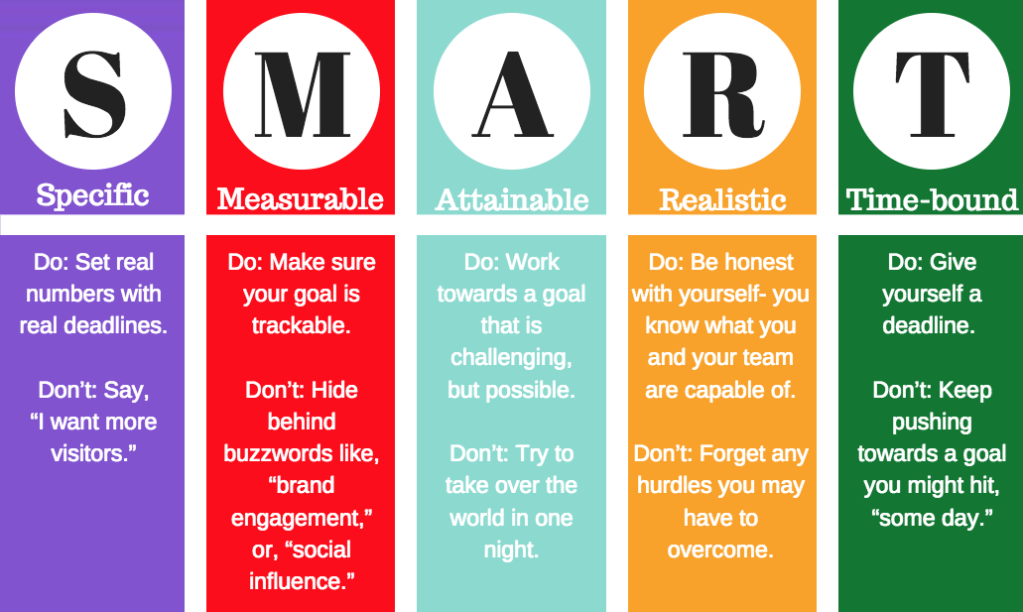
Your objective should follow the SMART rules! Especially T (time-bound) is very important, it not only helps to set the right expectation with your managers and XFN partners, but also help you to think through whether your goal is attainable in this quarter or to request additional resources when needed.
Document the OKRs properly so it’s easy to share and understand by your team members as well as XFN partners. Identify owners for each of the item to make the team feel a sense of ownership and help them understand how their work contributes to company’s goal and vision.

Execution and tracking
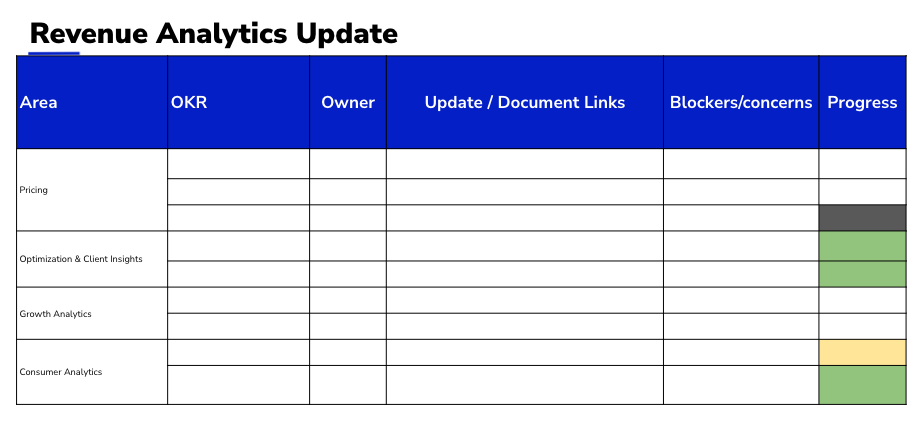
Once we have set deadline and key results in OKRs, we should always track our progress against it. I set up a weekly review template with my team leaders to collect their OKR progress every Monday morning and share that with my peers and my manager. I will check in and discuss blockers and reasons for delays if there is any.
I have seen people using Gantt Chart (free Google sheet template) or Asana tracker for more granular level of project management and OKR tracking.
Sometimes things happen and we need to reallocate resources for more urgent or impactful tasks for the business (trust me, that happens all the time at start-ups!). It’s ok to adjust OKR timeline as long as you communicate the underlying reasons and dependencies in-time, and reevaluating to come out with a new plan in the meantime.
Always plan and allocate your time according to Stephen Covey’s 4 Quadrants (worksheet). Your OKRs should be mostly in Quad II (Important & Not Urgent tasks to improve capability, develop new opportunities, relationship building, etc) , while it’s inevitable that you will have things come up in Quad I (Important and Urgent).
I hope what I shared so far is useful for whoever that read till here, and please feel free to share your thoughts at the comment section below!
References:
 Kathleen Li
Leave a comment